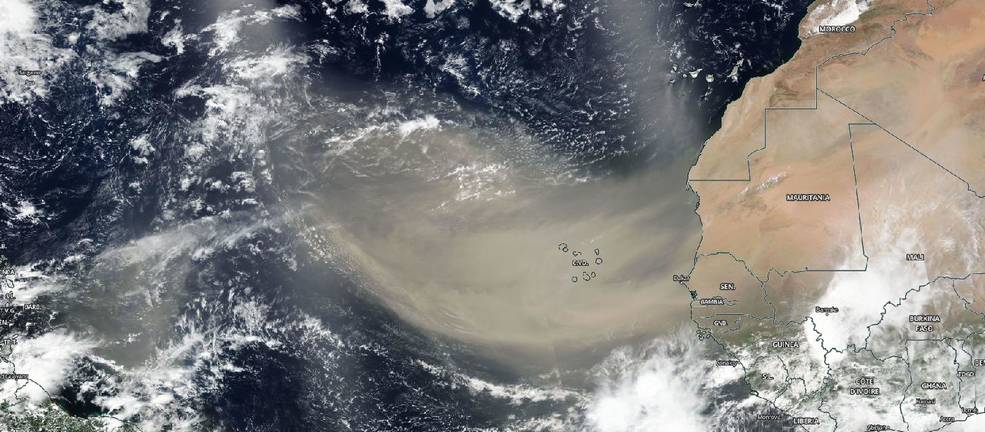
Mineral dust accounts for the majority of aerosol mass in the atmosphere and produces important impacts on the Earth system and society. This included degrading visibility and air quality, as well as perturbing the Earth’s radiation budget by seeding clouds and scattering and absorbing radiation. But these and other important impacts of dust remain poorly understood and quantified because global aerosol models have difficulty representing basic processes like dust emission and deposition, causing large errors between model predictions and measurements. In part, this is because small-scale processes like dust emission are difficult to represent accurately in coarse-resolution global models.
Recognizing the limitations of global aerosol models in representing the global dust cycle and its impacts on the Earth system, the aerosol-climate interactions research group at UCLA developed DustCOMM (Dust Constraints from joint Observational-Modelling-experiMental analysis). This is a continuously expanding dataset of constraints on the global dust cycle that combines observational and experimental constraints on dust properties and dust abundance with an ensemble of global aerosol model simulations. This results in more accurate constraints than possible from global modeling alone. Moreover, one unique advantage of DustCOMM is that it includes realistic uncertainties that have been propagated from the uncertainties in the experimental, observational, and modeling constraints used in obtaining the DustCOMM data sets.
Below are the data sets that are part of DustCOMM, along with links to the relevant articles and the links to download these data.
| Reference Study | Available Dataset | |
| Huang et al. 2023 | Single-scattering properties for ellipsoidal dust as a function of dust diameter (between 0.1 - 70 um), wavelength (13 values between 0.35 and 35 um), real refractive index (six values from 1.45 - 1.59) and imaginary refractive index (seven values from 5e-4 to 0.01) | Link to download |
| Adebiyi et al 2023 | Constraints on the following components of the global dust cycle, resolved by season and dust particle size, for dust with diameter > 20 um:
|
Link to download |
| Kok et al. 2023 | Historical evolution of dust loading from each of nine major source regions, from all of North Africa dust, from all of Asia, from all of the Southern Hemisphere, and from all desert dust. | Link to download |
| Meng et al. 2022 | Size distribution of emitted dust for diameter up to 100 um | Link to download |
| Kok et al 2021b | Constraints on the fractional contribution of each of nine major source regions to the following global dust cycle components, resolved by particle size and season:
|
Link to download |
| Kok et al 2021a | Constraints on the following components of the global dust cycle, resolved by season and dust particle size:
|
Link to download |
| Adebiyi & Kok 2020 | Constraints on globally-averaged atmospheric dust properties
|
Link to download |
| Adebiyi et al. 2020 | Constraints on 3D and 2D dust properties
|
Version 2 (Link to download) Version 1 (Link to download) |
| Kok et al. (2017) | Constraint on the size-resolved dust extinction efficiency that accounts for dust asphericity | Link to download |
Full citations to the relevant papers:
Licence: Dataset on this page is offered under a Creative Commons license unless otherwise noted.